



Introduction
Franchising is a business arrangement where an individual or company (the franchisee) operates under the branding, systems, and operational model of an established business (the franchisor). In exchange, the franchisee typically pays upfront franchise fees and ongoing royalties while following specific operational standards set by the franchisor. Within the laundromat sector, franchising often provides access to established workflows, equipment sourcing, branding support, and operational guidance, which can make market entry feel more structured for first-time business owners.
In simpler terms, franchising allows someone to run a business using an established brand and business model rather than creating one from scratch.
Franchising is often presented as a safer and more predictable route into business ownership. Instead of building a business model from the ground up, franchisees gain access to an established brand, operational systems, supplier networks, and structured guidance.
Disclaimer: This article is intended for general informational purposes only and should not be considered legal advice. Franchise agreements and regulatory obligations can vary significantly depending on the business model and contractual terms involved. Business owners should seek independent legal and professional advice before making any franchise or investment decisions.
Franchising in Singapore
For many entrepreneurs exploring the self-service laundry sector, franchising is an attractive way to enter the growing laundromat market in Singapore. Rising urban density, smaller residential units, dual-income households, and convenience-driven lifestyles continue to shape demand for modern laundry services.
However, while franchising may appear more structured on the surface, understanding franchise regulations remains critical before making any investment decision.
Singapore’s franchising environment differs significantly from markets with stricter statutory oversight. Unlike countries with highly centralised franchise legislation, Singapore operates within a comparatively flexible and contract-driven framework. This means the strength of your protection often depends less on a regulator and more on the quality of the agreement you sign.
For aspiring laundromat operators, this creates an important reality: entering a franchise system does not automatically remove business risk. In many cases, it simply changes the type of risks involved.
At the same time, laundromat operators must also comply with broader regulations, including zoning approvals, environmental requirements, and operational compliance standards that affect day-to-day operations.
Understanding how these areas intersect is essential for anyone evaluating an opportunity for a laundromat franchise in Singapore.
Key Takeaways
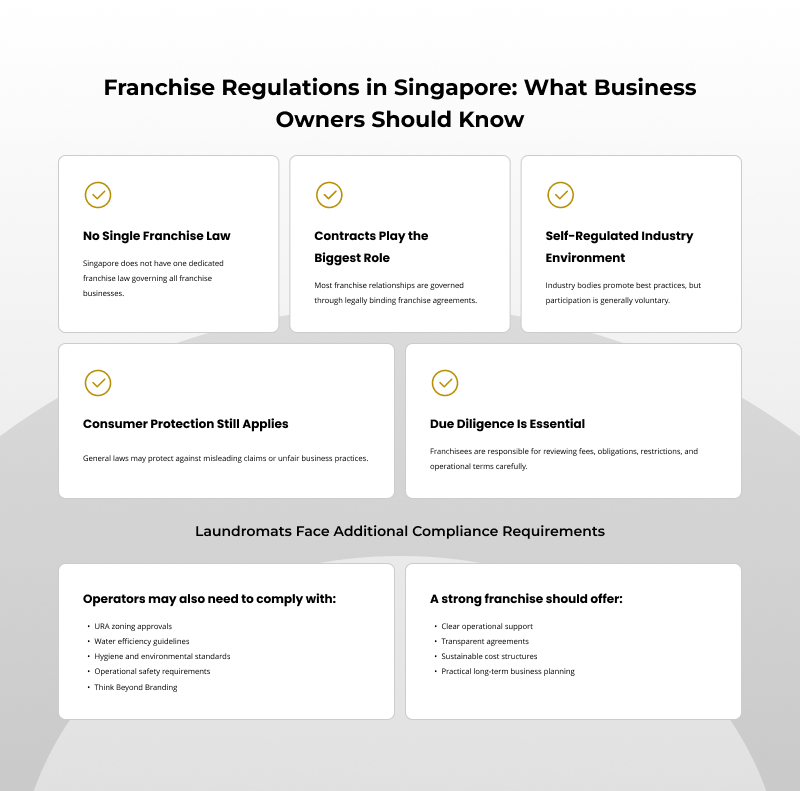
- Singapore does not have a single dedicated franchise law, so most franchise regulations rely heavily on contracts and general business legislation.
- Laundromat operators must navigate both franchise obligations and industry-specific compliance requirements such as zoning, water usage, and hygiene standards.
- Understanding long-term operational costs is just as important as evaluating franchise fees and brand support.
- Consumer protection laws offer limited safeguards, making due diligence and legal review essential before signing any agreement.
- A structured operational framework can help reduce uncertainty for first-time laundromat investors exploring the Singapore market.
Why Franchise Regulations Matter More Than Many First-Time Investors Realise
Many new business owners assume that buying into a franchise automatically means stronger legal protection. In practice, Singapore’s approach to franchise regulations places significant responsibility on the franchisee to evaluate agreements carefully before committing.
This creates a very different operating environment compared to heavily regulated franchise markets.
In jurisdictions with dedicated franchise legislation, franchisors may be required to provide standardised disclosure documents, audited financial information, cooling-off periods, or mandatory dispute resolution frameworks.
Singapore does not currently impose these same obligations under a single franchise-specific law.
As a result, much of the franchising landscape operates through:
- Contract law
- General commercial legislation
- Industry best practices
- Self-regulation
- Consumer protection frameworks
This flexibility can benefit both franchisors and franchisees, but it also means investors must take a far more active role in assessing business viability and contractual fairness.
For those considering starting a laundromat, understanding these realities early can help prevent costly operational and financial issues later.
The Hidden Risks of Franchising in Singapore
One of the biggest misconceptions surrounding franchising is that an established brand automatically guarantees business success.
While brand recognition and operational support can reduce certain startup challenges, franchising also introduces long-term obligations that independent operators may not face.
These include:
- Ongoing royalty fees
- Equipment procurement restrictions
- Operational control clauses
- Exclusive supplier arrangements
- Territory limitations
- Renewal restrictions
- Exit penalties
Under Singapore’s contract-based approach to franchise regulation, many of these obligations become legally enforceable upon signing.
For laundromat businesses, the financial implications can be substantial over time.
A franchise agreement that initially appears manageable may later become restrictive if:
- Utility costs increase
- Equipment maintenance expenses rise
- Consumer behaviour shifts
- Competition intensifies within the surrounding estate
This is particularly relevant in the context of franchising risks in Singapore, where long-term profitability may depend heavily on operational flexibility.
Understanding How Franchise Regulations Work in Singapore
Singapore does not have a single standalone franchise statute that governs all franchising activity.
Instead, franchise regulations operate through a combination of broader legal and commercial frameworks.
This includes:
- Contract law
- Company law
- Intellectual property law
- Competition law
- Consumer protection legislation
- Industry self-regulation
The practical outcome is that the franchise agreement itself becomes the primary governing document between franchisor and franchisee.
For laundromat investors, understanding every clause in the agreement is critical before proceeding with any investment in laundry business opportunities.
Contract Law Forms the Foundation of Franchise Regulations
At its core, franchising in Singapore is fundamentally contractual.
Once signed, the franchise agreement becomes legally binding and enforceable under Singapore law.
This means areas such as:
- Franchise fees
- Royalty structures
- Equipment requirements
- Brand usage rights
- Operational standards
- Renewal terms
- Termination conditions
are all governed primarily by the contract itself.
In practical terms, strong franchise regulations in Singapore depend heavily on how clearly and fairly the agreement is drafted.
For laundromat operators, several clauses warrant particular attention.
Royalty Structures and Long-Term Profitability
Royalty obligations may appear manageable during early financial projections, but can significantly affect long-term margins.
This is especially important in laundromat businesses where:
- Utility costs fluctuate
- Machine maintenance is ongoing
- Equipment replacement cycles are expensive
- Revenue may vary depending on location traffic
Understanding how royalties interact with operating costs is essential when evaluating franchise laws in Singapore from a commercial perspective.
Operational Control Clauses
Many franchisors impose strict operational standards to maintain brand consistency.
This can include:
- Approved detergent suppliers
- Pricing structures
- Equipment specifications
- Outlet design requirements
- Operating hours
- Customer service standards
While standardisation can strengthen brand identity, excessive control may limit flexibility in responding to local market conditions.
For example, operators may be restricted from adopting new technologies such as cashless laundry payment systems if they fall outside approved franchise specifications.
Exit Restrictions and Non-Compete Clauses
One often-overlooked aspect of franchise regulations involves exit planning.
Some agreements contain:
- High termination penalties
- Restrictions on resale
- Non-compete clauses
- Renewal uncertainty
For laundromat owners, this can affect long-term business mobility and future investment options.
Singapore’s Self-Regulated Franchising Environment
A useful way to understand Singapore’s franchising ecosystem is this:
In heavily regulated systems, legislation defines minimum standards for fairness.
In Singapore’s approach to franchise regulations, the contract often defines those minimum standards instead.
This places greater emphasis on:
- Due diligence
- Independent legal review
- Commercial evaluation
- Franchisor reputation
The Franchising and Licensing Association Singapore (FLA) plays an important role in encouraging ethical franchising practices.
The association promotes:
- Clearer franchise agreements
- Better disclosure practices
- Industry education
- Ethical conduct guidelines
However, it is important to recognise that:
- Membership is voluntary
- Guidelines are not legally enforceable
- Non-member franchisors can still operate freely
This creates varying levels of transparency across the market.
For laundromat investors, evaluating a franchisor’s operational maturity and support structure is just as important as reviewing the legal contract itself.
Consumer Protection Laws and Their Limitations
Although Singapore lacks franchise-specific legislation, franchisees may still receive limited protection under broader laws such as the Consumer Protection (Fair Trading) Act (CPFTA).
These protections may apply to:
- Misrepresentation
- False claims
- Unfair business practices
- Misleading advertising
However, these laws are largely reactive rather than preventative.
They may address misconduct after problems arise, but do not necessarily establish upfront disclosure requirements under current franchise regulations.
For example:
- Franchisors are not required to disclose full outlet performance data
- There is no mandatory standardised disclosure document
- Earnings projections may not reflect average outlet performance
This creates additional importance around independent financial assessment.
Why Laundromat Businesses Face Additional Regulatory Complexity
Understanding franchise regulations alone is not enough for self-service laundry operators.
Laundromats also operate within a broader compliance environment involving:
- Property usage approvals
- Environmental regulations
- Utility management
- Public hygiene expectations
- Equipment efficiency standards
This means operators must navigate both franchise obligations and National Environment Agency (NEA) regulations that affect laundry operations in Singapore simultaneously.
Zoning and Property Use Requirements
Before opening a laundromat, operators must ensure the chosen location complies with Urban Redevelopment Authority (URA) planning rules.
This may involve:
- Approved commercial usage
- Change-of-use applications
- Ventilation compliance
- Exhaust management
- Noise considerations
Additional restrictions may apply in:
- HDB shophouses
- Mixed-use developments
- Strata-titled units
Failure to obtain proper approvals can delay operations and increase setup costs.
These operational realities are an important part of the broader laundromat business regulations in Singapore.
Environmental and Water Efficiency Compliance
Laundromats are highly resource-intensive businesses.
Water consumption, drainage systems, and machine efficiency all play significant roles in long-term operating costs.
Singapore’s Public Utilities Board (PUB) promotes water efficiency measures within the commercial laundry sector, including:
- High-efficiency washing systems
- Water-saving technologies
- Consumption monitoring
- Recycling systems where feasible
These environmental considerations increasingly intersect with modern franchise regulations, especially when franchisors specify approved equipment standards.
Retrofitting inefficient systems later can become expensive and operationally disruptive.
Hygiene Standards and NEA Considerations
Maintaining cleanliness is critical within self-service laundry operations.
Operators may need to comply with broader NEA regulations involving:
- Wastewater management
- Hygiene practices
- Chemical handling
- Pest prevention
- Outlet cleanliness
Even unattended laundromats require consistent maintenance standards to preserve customer trust and operational compliance.
For franchise operators, this creates dual obligations:
- Brand compliance standards from the franchisor
- Local operational requirements from Singapore authorities
Evaluating a Laundromat Franchise More Strategically
Before entering any franchise agreement, prospective operators should evaluate more than just startup costs or branding appeal.
A stronger evaluation framework should include:
- Contractual flexibility
- Operational support quality
- Equipment efficiency
- Utility cost assumptions
- Site suitability
- Territory viability
- Exit planning
- Scalability potential
This becomes increasingly important within Singapore’s flexible system of franchise regulations.
Investors should also validate financial projections against real operating conditions rather than relying solely on optimistic revenue scenarios.
Questions Laundromat Investors Should Ask Before Signing
Before committing to any franchise system, operators should ask:
- How are royalties calculated?
- Are there minimum performance obligations?
- Can equipment vendors be changed later?
- Are utility costs realistically reflected in projections?
- What happens during equipment downtime?
- How restrictive are non-compete clauses?
- What support is provided during operational issues?
- Are upgrades mandatory in future franchise renewals?
These questions help clarify both operational realities and the practical implications of franchise regulations over time.
Independent vs Franchise Laundromat Models
Some operators may eventually compare franchise systems against independent laundromat ownership.
Franchises may provide:
- Faster setup processes
- Brand recognition
- Operational systems
- Structured workflows
Independent models may offer:
- Greater operational flexibility
- Higher long-term margin retention
- Supplier freedom
- Customised branding
- Greater pricing control
The right choice depends on experience level, risk appetite, and operational goals.
For many first-time operators, the decision often comes down to whether the support structure justifies the long-term contractual obligations imposed by existing franchise regulations.
Laundromat Franchising with Fresh Laundry
For many first-time business owners, understanding franchise requirements is only one part of the process. Laundromat operations also involve practical considerations such as equipment performance, workflow planning, maintenance coordination, and utility efficiency.
An Operationally Focused Approach
At Fresh Laundry, we take a more operationally grounded approach to laundromat setup and franchising in Singapore. Since 2006, we have worked across self-service laundromats, commercial laundry deployments, equipment leasing, and turnkey laundry solutions in environments ranging from retail laundromats to dormitories and hospitality spaces.
Support Beyond Branding
Our approach focuses heavily on operational structure and implementation support, including:
- equipment planning
- outlet workflow setup
- machine installation
- maintenance coordination
- technical support
- operational guidance
As a licensed distributor of Speed Queen and Alliance Laundry Systems equipment, we also work closely with commercial-grade machines designed for continuous operational use.
Adapting to Different Operating Environments
Different laundromat environments often require different operational considerations. Residential HDB clusters, dormitories, mixed-use developments, and hospitality spaces may exhibit distinct customer usage patterns, operational demands, and maintenance requirements. This is why operational planning often needs to be adapted to the realities of each specific environment rather than relying entirely on a standardised setup model.
Frequently Asked Questions
Are franchises regulated in Singapore?
Yes, but there is no single franchise-specific law. Instead, franchise regulations in Singapore operate through contract law, general legislation, and industry guidelines.
What are the main risks of franchising in Singapore?
Common risks include restrictive contracts, royalty obligations, limited disclosure requirements, and operational limitations imposed by franchisors.
Do laundromats require regulatory approvals in Singapore?
Yes. Operators may need to comply with zoning approvals, environmental requirements, water efficiency standards, and hygiene regulations, depending on the business model.
What are some important regulations in Singapore relevant to laundromat businesses?
Important laundromat business regulations in Singapore may include URA property-use rules, PUB water-efficiency guidelines, and operational hygiene standards.
Are NEA regulations relevant for laundromats?
Yes. Certain NEA regulations in Singapore may apply to wastewater handling, cleanliness standards, chemical management, and environmental hygiene.
Is franchising safer than running an independent laundromat?
Franchising can reduce certain startup risks through branding and operational support, but it also introduces contractual and financial obligations under Singapore’s system of franchise regulations.
Conclusion
Franchising can offer a more structured path into business ownership, but structure should never be mistaken for guaranteed protection.
Singapore’s approach to franchise regulations gives business owners flexibility, but it also places greater responsibility on franchisees to evaluate contracts, operational models, and long-term obligations carefully before investing.
For laundromat businesses, these considerations become even more important due to the additional layers of operational compliance, water efficiency requirements, equipment planning, and ongoing maintenance demands involved in running a self-service laundry operation.
This is why clarity, operational guidance, and practical implementation support matter just as much as branding itself.
If you are exploring the laundromat space and want a more structured and reliable approach to business setup, we at Fresh Laundry provide guidance across planning, operational workflows, equipment configuration, and implementation support tailored to Singapore’s operating environment. Whether you are evaluating whether to start a laundromat independently or considering a franchise route, our team helps simplify the process with a more cohesive, operationally grounded approach.
Contact us if you want clearer guidance on navigating the setup of a laundromat, operational planning, and long-term business considerations in Singapore’s evolving self-service laundry market.
 Login with Google