


The Quiet Expansion of Singapore’s Laundromat Industry
The laundromat industry in Singapore has historically operated quietly in the background of daily life. For many years, laundromats were simply viewed as neighbourhood convenience services used occasionally for large loads or bulky household items. Today, however, the industry is expanding more visibly across residential areas, with self-service laundry outlets appearing in HDB estates, mixed-use developments, and suburban commercial zones.
This growth is not random. Several structural changes within Singapore’s economy and urban environment are gradually shaping how people manage everyday tasks such as laundry. Housing patterns, lifestyle changes, and technology adoption are all contributing to a shift in how laundry services are used.
Unlike trend-sensitive retail sectors, the laundromat industry is built around a recurring household need. Laundry remains a routine task regardless of economic conditions. When services are designed to save time, improve accessibility, and operate efficiently, demand often follows naturally.
Singapore’s climate also quietly reinforces this demand. High humidity levels and frequent rainfall can make line-drying difficult, particularly during monsoon periods. With smaller apartment layouts and busy work schedules, many residents increasingly view laundromats as practical extensions of their home laundry routines rather than as emergency alternatives.
The rise of the laundromat industry can therefore be understood through a broader lens. It reflects larger shifts in urban living, convenience consumption, automation adoption, and the growing role of neighbourhood service businesses within residential ecosystems.
Why Investors Are Paying More Attention to the Laundromat Business
The laundromat industry is attracting growing attention from entrepreneurs and small-business investors in Singapore. Modern laundromats are no longer viewed purely as basic utility services, but as scalable neighbourhood businesses supported by automation, recurring demand, and convenience-driven consumer behaviour.
Unlike trend-sensitive retail sectors, the laundromat industry serves a consistent household need. Laundry remains part of everyday life, which creates steady usage patterns across residential communities.
Technology has also changed how laundromats operate. Features such as remote monitoring, automated systems, and cashless laundry payment systems allow operators to manage outlets more efficiently with leaner manpower requirements.
Singapore’s dense urban environment further supports this business model. Many laundromats are located within HDB estates and mixed-use developments where residents increasingly rely on nearby neighbourhood service businesses for daily convenience.
This shift allows providers like Fresh Laundry to support entrepreneurs by offering scalable laundromat concepts, modern commercial laundry infrastructure, and operational insight to maximise these investment signals.
Key Takeaways
- Singapore’s laundromat industry is expanding due to dense urban housing, convenience-driven lifestyles, and changing household habits.
- Modern laundromats increasingly rely on automation, including cashless laundry payment systems and remote machine monitoring.
- The growth of neighbourhood service businesses has created strong demand for accessible, self-service laundry solutions within residential estates.
- Consumer expectations are shifting towards faster, more flexible, and on-demand laundry solutions that complement home appliances.
- Fresh Laundry supports entrepreneurs and operators with scalable laundromat concepts, operational insight, and modern commercial laundry infrastructure.
Why the Laundromat Industry Fits Singapore’s Urban Landscape
High-Density Housing Supports Neighbourhood Services
Singapore’s residential structure naturally supports neighbourhood-based convenience services. With a large proportion of the population living in HDB estates and high-rise residential developments, daily errands are increasingly consolidated within nearby commercial clusters.
This environment creates favourable conditions for the laundry retail ecosystem because laundromats operate like other practical, recurring services, such as convenience stores, clinics, and food outlets. Residents prefer nearby access for routine needs, especially for errands that can be completed quickly and repeatedly.
Several urban characteristics support laundromat demand:
- High residential population density
- Integrated residential and retail developments
- Walkable neighbourhood planning
- Consumer preference for nearby convenience services
- Limited travel time between home and amenities
These patterns make laundromats particularly suited to residential estates where convenience strongly influences consumer behaviour.
Space Constraints Continue to Influence Laundry Habits
Singapore’s urban housing environment also shapes how residents approach laundry. Although many homes own washing machines, practical limitations still exist.
Smaller apartment sizes may limit the types or sizes of appliances households can accommodate. Bulky household items such as comforters, curtains, and rugs often exceed the practical capacity of standard home machines. Drying large loads indoors can also become inconvenient during periods of high humidity.
This is where the commercial laundromat market fills an operational gap.
Large-capacity washers and dryers available through Fresh Laundry’s commercial laundry machines allow residents to manage oversized laundry loads more efficiently without needing additional space at home. Instead of replacing household appliances entirely, laundromats often complement them.
The expansion of integrated retail within residential estates further reinforces this behaviour. Residents increasingly complete multiple errands within a single neighbourhood trip, making laundromats part of a broader convenience ecosystem.
How Singapore’s Climate Quietly Supports the Laundromat Industry
Singapore’s tropical climate also plays a subtle but important role in supporting the laundromat industry. High humidity levels, frequent rainfall, and extended monsoon periods can make drying clothes outdoors difficult, especially in high-rise residential environments where indoor drying space may already be limited.
For many households, bulky items such as bedsheets, comforters, curtains, and rugs may take significantly longer to dry naturally during wet weather. This can cause inconvenience, odours, or moisture-related issues in smaller living spaces.
As a result, many residents increasingly rely on laundromats for faster and more predictable washing and drying cycles. Commercial dryers are generally designed to handle larger loads more efficiently than household appliances, which makes laundromats particularly useful during prolonged rainy periods.
Consumer Behaviour Is Reshaping the Laundromat Industry
Convenience Has Become a Core Consumer Priority
Modern lifestyles in Singapore continue to become increasingly time-sensitive. Many households balance long working hours, caregiving responsibilities, commuting, and household management simultaneously.
Within this context, convenience-driven services have gained importance across many sectors, including the laundromat industry.
Commercial washers and dryers often handle loads several times larger than those of standard household appliances, significantly reducing the time required for large laundry sessions. Residents can wash and dry multiple loads simultaneously while freeing up valuable time at home.
Several behavioural shifts continue supporting the laundromat industry:
- Preference for faster household task completion
- Demand for flexible operating hours
- Increased use of self-service convenience models
- Greater willingness to outsource repetitive chores
- Growing reliance on on-demand laundry solutions
These habits are gradually normalising laundromat usage as part of regular household routines rather than occasional backup solutions.
24-Hour Accessibility Changes Usage Patterns
Another major factor influencing the laundromat industry is operational flexibility.
Many laundromats now operate late into the night or around the clock. This flexibility appeals to shift workers, working professionals, students, and families managing irregular schedules.
Unlike traditional service businesses with fixed operating hours, self-service laundromats allow consumers to integrate laundry into their personal schedules rather than planning around business timings.
This operational flexibility also strengthens the role of laundromats within neighbourhood businesses, where accessibility and convenience directly influence recurring customer behaviour.
Technology Is Modernising the Laundromat Industry
Automation Is Changing Operational Economics
Automation has become one of the strongest growth signals within Singapore’s laundromat industry.
Modern laundromats increasingly rely on systems that reduce manual operational requirements while improving consistency and reliability. These technologies help operators manage outlets more efficiently while creating a smoother user experience for customers.
Key technologies shaping the laundromat industry include:
- Remote machine monitoring
- Automated detergent dispensing
- Digital machine diagnostics
- Usage analytics and performance tracking
- Cashless laundry payment systems
The shift towards cashless systems is particularly significant. Consumers increasingly expect digital convenience across all services, including laundry. QR code payments, mobile wallets, and app-based systems now align laundromats with broader cashless consumer behaviour in Singapore.
This transition also improves operational efficiency for operators by reducing cash handling requirements and streamlining transaction management.
The rise of the cashless laundromat model reflects how the laundromat industry continues to evolve alongside broader retail automation trends.
Automation Makes Expansion More Scalable
Automation also affects scalability within the laundromat industry.
Compared with manpower-intensive service businesses, laundromats benefit from relatively streamlined daily operations once systems are established. Automated systems allow operators to monitor multiple locations with reduced staffing requirements.
This creates opportunities for gradual network expansion across residential districts without requiring proportionally larger labour structures.
As Singapore continues to face labour cost pressures and manpower constraints, automated business models may become increasingly attractive in neighbourhood-based services.
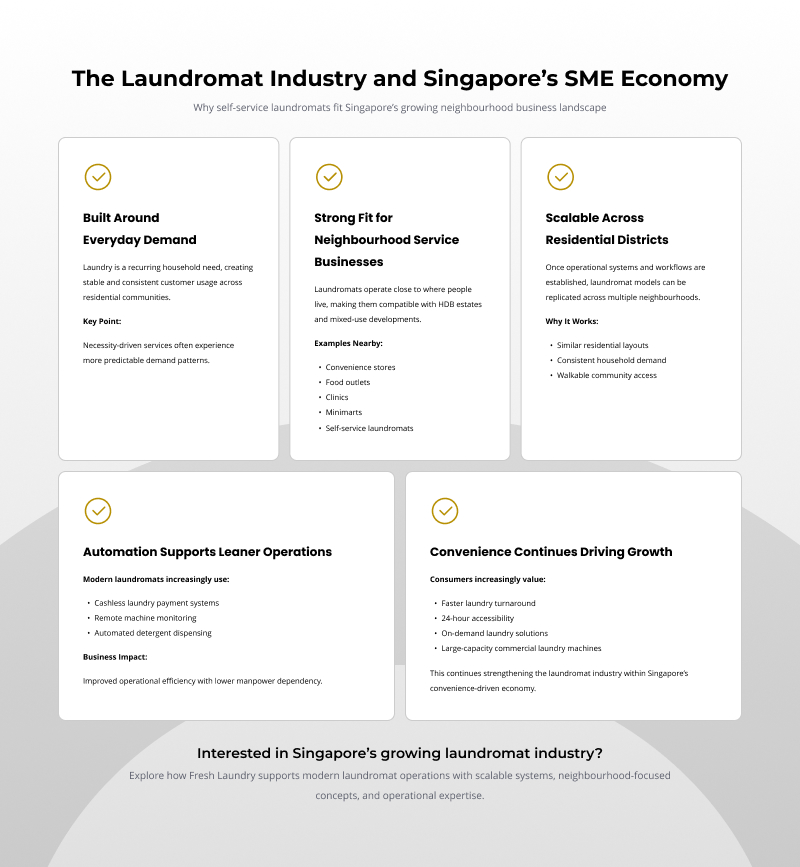
The Laundromat Industry and Singapore’s SME Economy
A Natural Fit for Neighbourhood-Based Business Models
Small and medium enterprises remain a core part of Singapore’s economy, accounting for the majority of businesses nationwide.
The automated laundry service industry aligns naturally with Singapore’s SME ecosystem because laundromats typically operate as location-based neighbourhood businesses serving recurring local demand.
Several factors support this compatibility:
| Business Characteristic | Why It Supports Growth |
| Local customer base | Demand comes from nearby residents |
| Essential household service | Laundry remains a recurring need |
| Replicable business model | Similar residential areas allow expansion |
| Operational automation | Lower manpower dependency |
| Flexible outlet sizing | Suitable for different retail spaces |
This structure allows operators to expand strategically into residential districts where demographic and housing conditions are favourable.
As more consumers embrace convenience-driven lifestyles, the self-service laundry sector increasingly resembles other scalable service businesses built around recurring utility rather than discretionary spending.
Franchising and Replication Continue to Grow
The visibility of the coin laundry franchise in Singapore also reflects growing confidence within the sector.
Franchise-style expansion allows operators to replicate systems, branding, equipment standards, and operational workflows across multiple neighbourhoods. This supports more consistent service quality while reducing some of the uncertainty faced by first-time operators.
The availability of standardised systems, supplier relationships, and operational processes also lowers certain barriers to entry compared with highly specialised retail sectors.
Emerging Market Signals Behind Continued Growth
Consumer Expectations Continue to Evolve
Several ongoing market signals suggest that Singapore’s laundromat industry may continue evolving in the years ahead.
Consumers increasingly value services that are:
- Convenient
- Accessible
- Digitally integrated
- Time-efficient
- Available within residential neighbourhoods
These expectations align closely with how modern laundromats operate.
Newer outlets increasingly incorporate larger machine capacities, app integrations, air-conditioned waiting areas, and digital payment ecosystems. Some outlets are even designed as hybrid lifestyle spaces combining laundry services with cafés or seating areas.
This reflects a broader shift in how consumers perceive convenience services. The industry is gradually evolving beyond basic utility towards a more experience-driven neighbourhood service model.
The Role of Equipment Innovation
Equipment innovation also continues shaping the industry.
Modern coin-operated washing machine solutions now offer:
- Faster extraction speeds
- Improved energy efficiency
- Larger drum capacities
- Lower water consumption
- Smarter usage tracking
These improvements support operational sustainability and enhance the customer experience.
At the same time, commercial-grade machines increasingly allow laundromats to handle a broader range of household needs beyond regular clothing loads, further strengthening their role within modern urban living.
Frequently Asked Questions
Is the laundromat industry growing in Singapore?
Yes. The industry in Singapore has expanded steadily due to urban living patterns, convenience-focused consumer behaviour, and the increasing use of automation technologies.
Why do people still use laundromats if they own washing machines?
Many households use laundromats for bulky items such as bedding, curtains, and rugs. Commercial machines can often handle larger loads more efficiently and complete drying cycles faster than home appliances.
How do cashless laundry payment systems benefit laundromats?
Cashless payment systems improve convenience for customers while reducing cash handling for operators. They also support operational tracking, digital monitoring, and smoother transaction management.
Why are laundromats common in HDB neighbourhoods?
High-density residential estates create consistent local demand for practical convenience services. Laundromats fit naturally within neighbourhood retail ecosystems where residents complete recurring errands nearby.
Are laundromats considered essential neighbourhood businesses?
In many residential areas, laundromats function similarly to other essential neighbourhood services by meeting recurring household needs conveniently and consistently.
Fresh Laundry and the Future of Singapore’s Laundromat Industry
As the industry continues evolving, experienced operators play an increasingly important role in shaping service quality, operational standards, and scalable business models.
Fresh Laundry has established itself in Singapore’s self-service laundry sector by focusing on modern laundromat concepts centred on residential convenience, operational efficiency, and scalable infrastructure.
This includes:
- Strategic neighbourhood placement
- High-capacity laundry machines
- Automation-focused operations
- Support for entrepreneurs entering the industry
- Systems designed around modern convenience expectations
As consumer habits continue to shift towards accessible laundry solutions, laundromats are likely to remain an increasingly visible part of Singapore’s residential service economy.
Contact us to learn more about how you can be part of the laundromat industry in Singapore. Explore modern laundromat models and understand how neighbourhood-focused laundry businesses continue adapting to changing urban lifestyles today.
 Login with Google