


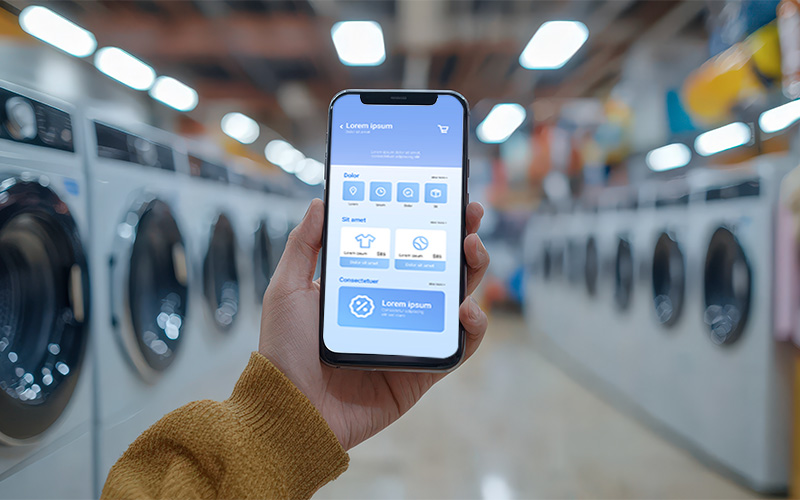
The Shift from Basic Service to Business Ecosystems
The laundromat industry has evolved significantly in recent years. What was once viewed as a straightforward equipment-led business is increasingly being shaped by technology, customer expectations, and operational efficiency.
This change is especially visible in Singapore.
Operators today are navigating an environment shaped by rising rental pressure, labour limitations, and customers who increasingly expect convenience as a standard rather than a premium feature. Simply installing commercial washers and opening a storefront is no longer sufficient to create long-term competitive advantage.
As a result, laundromats are beginning to move away from standalone service points towards structured business ecosystems.
This is where augmented service becomes important.
Originally rooted in service and marketing theory, augmented service refers to the additional layers of value surrounding a core offering. Rather than delivering only the essential function, businesses improve the overall experience through support systems, technology, operational guidance, accessibility, and customer-focused enhancements.
For laundromats, this shift changes how operators think about the business.
Success is becoming less dependent on having machines alone and more dependent on creating an environment that is easier to operate, easier to scale, and easier for customers to use.
Singapore’s Increasingly Digital Economy
The growing emphasis on service ecosystems aligns closely with the way businesses and consumers in Singapore interact with services today. Across industries, there has been a broader shift towards digital transactions, automation, and connected customer experiences, supported by strong adoption of cashless payments, self-service technologies, and smart infrastructure.
Consumers have become accustomed to using apps to order food, track deliveries, make payments, and manage everyday tasks with minimal friction. These expectations increasingly extend into physical service environments as well. Customers now value speed, visibility, convenience, and reliability alongside the core service itself.
For laundromat operators, this shift creates an opportunity to rethink how outlets are designed and managed. Features such as digital payment systems, machine status visibility, remote monitoring, and streamlined operational workflows are becoming increasingly relevant in Singapore’s operating environment, where manpower efficiency and customer convenience often influence business performance.
In this context, building a stronger support and technology layer around the laundry experience is not simply a trend. It reflects a broader evolution in how Singaporean businesses deliver services and how customers increasingly expect to engage with them.
Key Takeaways
- Augmented service expands laundromat value beyond washing and drying by improving convenience, operations, and customer experience.
- Modern laundromats increasingly compete through integrated systems rather than equipment alone.
- Technology, automation, and operational support can improve consistency and reduce day-to-day management complexity.
- Business owners should evaluate the surrounding service ecosystem instead of focusing only on machines and setup costs.
- At Fresh Laundry, we believe a more integrated and structured operating model can support a smoother path into laundromat ownership.
What Is Augmented Service?
At its simplest, it means extending a service beyond its fundamental function.
Customers still receive the original service.
However, additional systems, support mechanisms, and enhancements improve the overall experience.
To understand this more clearly, it helps to compare core service vs augmented service.
Core Service in a Laundromat
Core service refers to the basic function customers are paying for.
This includes:
- Access to washing machines
- Access to dryers
- Water and utilities
- Laundry completion
Without these components, a laundromat cannot operate.
Augmented Service in a Laundromat
Examples include:
- Digital payment infrastructure
- Customer support channels
- Maintenance coordination
- Machine status visibility
- Operating procedures
- Usage insights
- Service consistency systems
The machines remain important, but the surrounding systems increasingly influence customer satisfaction and operational outcomes.
For customers, these enhancements often feel invisible until they disappear.
When payment becomes difficult, machines frequently go offline, or service recovery is slow, the business experience deteriorates quickly.
This explains why augmented service increasingly shapes business performance across service industries.
Why Businesses Are Investing More in Augmented Service
Businesses historically competed through physical advantages:
- Better locations
- More inventory
- Lower pricing
- Larger facilities
Over time, these advantages became easier to replicate.
Service quality became the next battleground.
Today, consumers increasingly expect:
- Immediate access
- Frictionless transactions
- Greater transparency
- Consistent experiences
- Faster support
Businesses that respond to these expectations often create stronger customer loyalty and more resilient operations.
As such, these enhanced offerings have become increasingly common.
Retail and E-Commerce
Retailers now compete through:
- Delivery tracking
- Membership ecosystems
- Personalised experiences
Hospitality
Hotels increasingly offer:
- Digital check-in
- Integrated guest platforms
- Concierge support
Healthcare
Healthcare providers increasingly support patients through:
- Follow-up systems
- Appointment reminders
- Ongoing engagement
These examples demonstrate how value-added services in business create advantages that extend beyond the core offering itself.
Laundromats are beginning to follow the same pattern.
Why Laundromats Are Particularly Well-Suited for Augmented Service
Laundromats appear simple at first glance.
Customers enter, complete laundry, and leave.
Operationally, however, there are many moving parts.
Operators must manage:
- Machine uptime
- Payment collection
- Customer experience
- Maintenance schedules
- Outlet cleanliness
- Utilities
- Service recovery
As outlets increase, complexity multiplies.
This makes the added services especially valuable.
Instead of solving problems manually, operators can create systems that improve predictability and reduce friction across the business.
Why Augmented Service Is Reshaping Modern Laundromats
Customers Expect More Than Functional Machines
Many customers no longer compare laundromats to one another.
They compare every service interaction against the digital experiences they already receive elsewhere.
Consumers are increasingly accustomed to:
- Mobile payments
- Real-time information
- Self-service convenience
- Seamless experiences
As expectations evolve, operators relying solely on machine availability may struggle to differentiate themselves.
This is where augmented service becomes meaningful.
Small improvements often influence perception more than major capital expenditure.
Examples include:
- Easier payment
- Clearer instructions
- Better communication
- Cleaner environments
- Faster issue resolution
Collectively, these create stronger customer confidence.
Operational Complexity Is Increasing
Singapore’s operating environment rewards efficiency.
Even relatively lean business models face challenges from:
- Labour costs
- Outlet supervision
- Equipment coordination
- Operational downtime
Traditional approaches often require manual oversight and reactive problem-solving.
Augmented service introduces structure.
Instead of relying heavily on operator intervention, systems are beginning to support everyday decisions.
This often improves:
- Resource allocation
- Maintenance planning
- Service consistency
- Operational visibility
Technology Is Becoming the Foundation of Service Enhancement
Technology does not replace good operations.
It strengthens them.
One practical example is remote monitoring of laundry machines.
Monitoring systems may allow operators to:
- View machine availability
- Track utilisation patterns
- Detect outages earlier
- Improve maintenance response
This reduces the need for constant physical checks.
Another growing category is Internet of Things (IoT) solutions for laundromats.
IoT (Internet of Things) refers to a network of connected devices that collect, share, and exchange data in real time to improve monitoring, automation, and operational decision-making.
Connected systems increasingly support:
- Automated machine reporting
- Data-driven maintenance
- Usage tracking
- Centralised operational visibility
Technology becomes valuable because it simplifies decision-making and reduces uncertainty.
Why Equipment Alone Is Becoming Less Competitive
Buying machines is increasingly straightforward.
Building reliable operations is harder.
Hardware can often be matched.
Processes and operating ecosystems are more difficult to replicate.
This is why augmented service increasingly becomes the real differentiator.
The strongest laundromat businesses often combine:
- Reliable equipment
- Operational systems
- Customer convenience
- Structured support
Rather than depending on any one element alone.
What Augmented Service Looks Like in a Modern Laundromat
Customer-Facing Enhancements
Customers interact most directly with visible layers of augmented service.
Examples include:
Cashless Transactions
Modern operators increasingly implement cashless laundry systems to simplify transactions and reduce physical cash handling.
Better Customer Journeys
This may include:
- Clear service instructions
- Digital interfaces
- Faster support resolution
More Predictable Experiences
Customers value knowing that machines are available and functioning reliably.
Small conveniences often improve repeat usage.
Operator-Facing Enhancements
Customers see the front end.
Operators benefit from backend improvements.
Examples include:
- Centralised oversight
- Maintenance workflows
- Performance reporting
- Reduced manual intervention
These improvements allow operators to focus more on business performance and less on daily troubleshooting.
Support Systems That Reduce Business Friction
Strong service ecosystems often include:
- Setup guidance
- Equipment planning
- Operational onboarding
- Maintenance coordination
This becomes particularly relevant for operators starting a laundromat, where experience gaps can create avoidable inefficiencies.
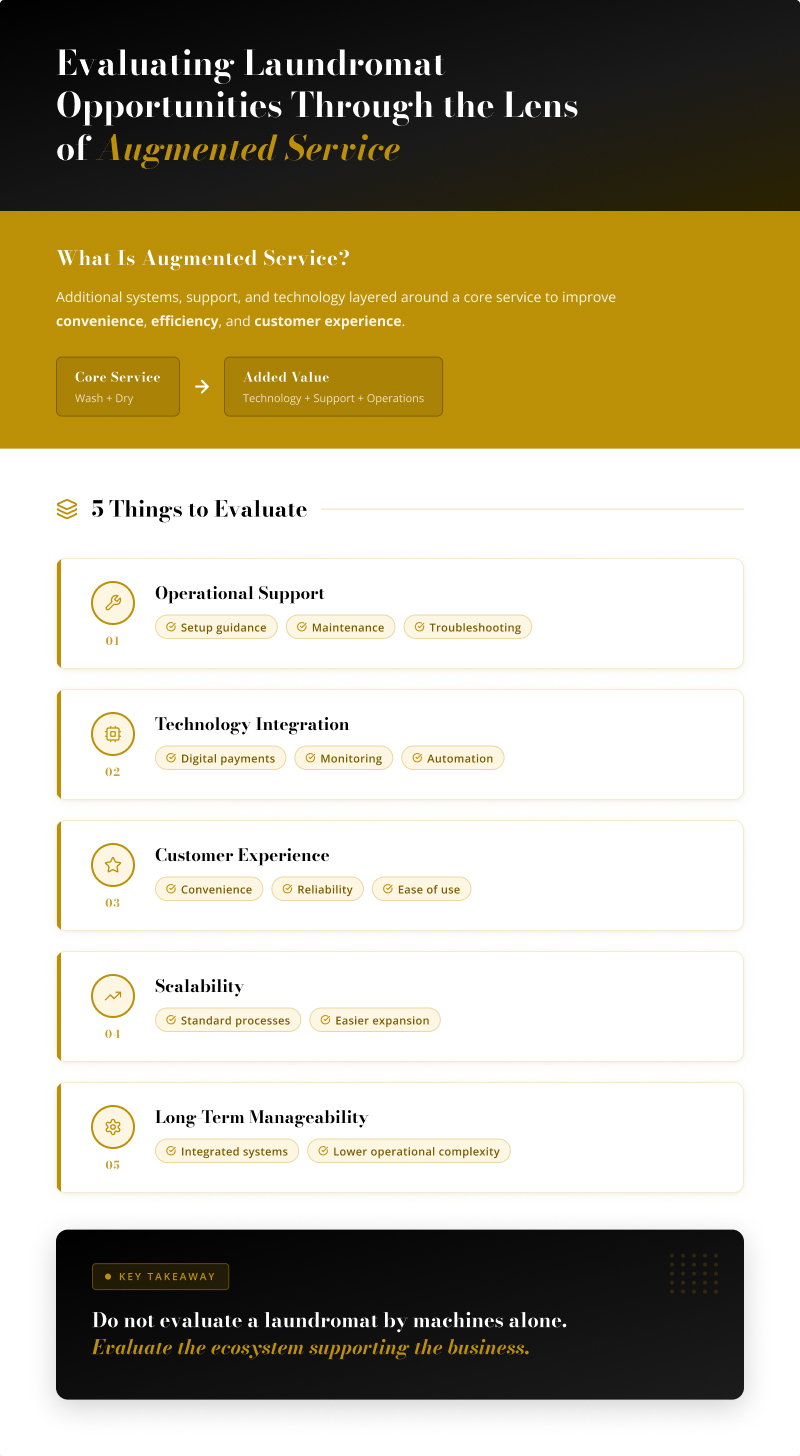
Evaluating Laundromat Opportunities Through the Lens of Augmented Service
When evaluating laundromat models, many business owners focus primarily on:
- Machine specifications
- Rental costs
- Installation budgets
These factors remain important.
However, they only represent part of the picture.
Questions worth asking include:
- What operational support exists after launch?
- How are maintenance issues handled?
- Are payment and monitoring integrated?
- What systems reduce manual involvement?
- How easy is outlet replication?
For operators exploring a laundromat franchise in Singapore, these questions may become even more important as scale increases.
Similarly, evaluating the surrounding service ecosystem can provide a more complete perspective on any investment for a laundry business.
At Fresh Laundry, we increasingly approach laundromat development through this broader operating lens.
Rather than focusing solely on equipment supply, we support operators with planning, operational guidance, machine configuration, and integrated systems tailored to Singapore’s environment.
How Fresh Laundry Applies This Service-Led Approach to Retail Laundromats
Understanding the concept is one thing. Seeing how it translates into an actual laundromat setup makes the idea more practical.
At Fresh Laundry, we approach retail laundromats as more than equipment installations. Our retail laundromat model is designed around creating a complete operating environment that supports business owners from planning through day-to-day operations.
Turn Empty Units Into Ready-to-Operate Laundromats
For many first-time operators, one of the biggest challenges is knowing where to begin.
Beyond purchasing machines, operators often need to make decisions around outlet layout, workflow, customer movement, equipment placement, and overall usability.
Fresh Laundry supports this process through a turn-key approach that helps transform empty retail units into operational laundromats through structured planning and implementation guidance. Complimentary consultations, conceptual drawings, and design support are also part of the planning process.
Build Around Operations, Not Just Equipment
A common mistake in laundromat planning is treating machine selection as the entire business model.
In practice, machine performance is only one part of the operating equation.
At Fresh Laundry, our approach considers:
- Outlet flow and customer usability
- Equipment configuration
- Operational practicality
- Long-term maintainability
- Ease of day-to-day management
Rather than treating setup and operations as separate stages, the goal is to create a more cohesive business system from the outset.
Support That Extends Beyond Launch
Launching a laundromat is only the beginning.
Operational continuity often depends on maintenance responsiveness, technical support, and having systems that reduce unnecessary disruption.
Fresh Laundry supports laundromat operators through equipment servicing, maintenance, repair support, and technical assistance to help outlets maintain smoother operations over time. The business also offers equipment leasing and rental options that may reduce the need for heavier upfront capital commitments for some operators.
A More Structured Way to Enter the Laundromat Industry
For operators evaluating opportunities in the laundromat space, the value of a supported model often comes from how the individual components work together.
Planning, equipment, support, and operations may appear separate on paper, but when designed within a single framework, they can create a more manageable operating experience.
This reflects the broader shift discussed throughout this article: successful laundromats are increasingly built not only around washers and dryers but also around systems that make the business easier to run and for customers to return to.
Frequently Asked Questions
Is augmented service only relevant for large franchises?
No. Smaller operators may also benefit significantly from structured systems and operational support.
Does augmented service increase startup costs?
Some features may require upfront investment, but improved efficiency and reduced operational friction can create longer-term value.
Can laundromats operate successfully without augmented service?
Yes. However, operators may require more hands-on involvement and may need to develop systems independently.
Which element of augmented service creates the biggest impact?
Technology integration and operational support often provide the most immediate improvements.
Does augmented service help scalability?
Yes. Standardised processes and structured systems generally make it easier to replicate successful operations.
Building More Than Just a Laundromat
The laundromat industry is increasingly moving beyond machines and physical locations.
As customer expectations evolve and operational demands become more complex, businesses are beginning to compete through ecosystems rather than infrastructure alone.
It is not about replacing the core laundry function. It is about strengthening it through technology, support systems, operational structure, and customer experience.
At Fresh Laundry, we take this approach by combining operational planning, machine configuration, integrated systems, and implementation support into a more connected business model. Rather than leaving operators to coordinate multiple moving parts independently, our goal is to create a more structured and manageable path into laundromat ownership.
If you are exploring opportunities in Singapore’s laundromat industry, contact us to discover how a more integrated operating approach can support long-term growth and operational confidence.
 Login with Google